TRACE / TRAUMA-INFORMED UX RESEARCH + PRODUCT DESIGN
Care between
the moments.
A gentle way to remember small experiences, notice what repeats, and choose support that fits the moment.


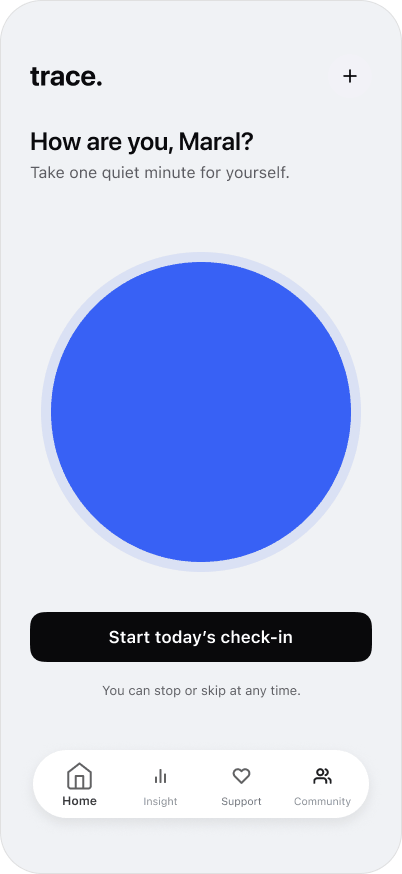


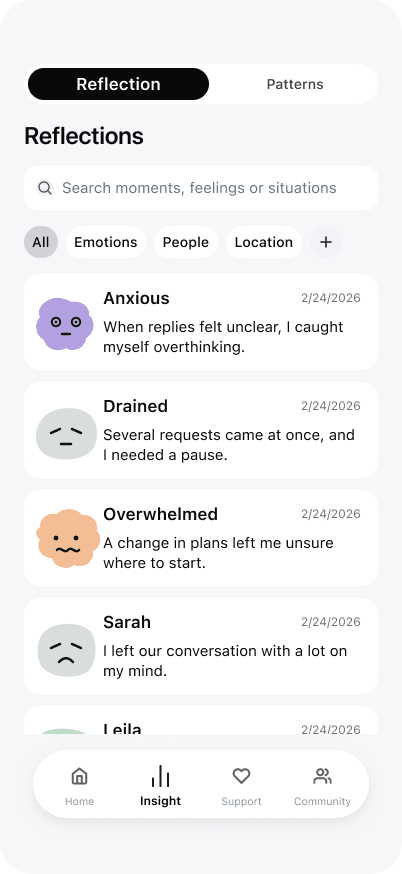
Small steps. Clearer patterns. Your choice.
TRACE / 2026
ROLE
UX research + product design
RESEARCH
IRB-approved interviews · 5 adults
DESIGN SCOPE
425 iOS screen frames
02 / PROJECT FRAME
A memory aid for the moments
that therapy cannot see.
Using a trauma-informed design lens, Trace explores how an iOS experience could preserve the context of emotional moments, reveal recurring patterns, and help people bring clearer examples into support conversations.
THE DESIGN PROBLEM
A feeling survives.
The story around it often does not.
After an intense moment, the event, response, and body cues may be difficult to reconstruct. A mood score alone cannot carry that context into later reflection.
MY ROLE
I was the sole researcher and designer, leading Trace from research and synthesis through product strategy, interface design, and prototyping.
PROJECT OUTPUT
A high-fidelity iOS concept across 16 flow groups, including exercise stages and alternate states.
IRB-approved research / Five participant interviews / High-fidelity iOS prototype
03 / SECONDARY RESEARCH
From the literature to
the tools people already use.
I reviewed ecological momentary assessment, self-tracking, engagement, and trauma-informed design, then compared adjacent products for the patterns they make easy—and the context they leave out.
SECONDARY RESEARCH
01 / Capture close to the moment
In-the-moment reporting can preserve everyday context and reduce the need to reconstruct an event later.
02 / Connect feeling to context
An emotion becomes more useful for reflection when it sits alongside situations, actions, and body signals.
03 / Keep tracking flexible
Sensitive experiences call for low effort, transparent choices, and a way to step back.
LENS / EMA reviews · HCI self-tracking · trauma-informed principles
FOCUSED PRODUCT REVIEW
Daylio
Fast mood + activity logging
Bearable
Custom factors and correlation reports
How We Feel
Emotion vocabulary and check-ins
Finch
Playful care goals and encouragement
OPPORTUNITY
Carry event + response + feeling into a useful reflection.
DESIGN IMPLICATION / Make capture small, keep context intact, and give people control over revisiting it.
04 / PRIMARY RESEARCH
The feeling stays.
The context fades.
With IRB approval for this project, I interviewed five adults about what happens between therapy sessions: the moments they remember, the details that disappear, and the support they need before reflecting.
05
adults with 12+ therapy sessions
Semi-structured interviews and co-creation explored recall, stress, privacy, tracking habits, and early concepts.
01
The moment becomes hard to explain.
A feeling may remain vivid while the event, response, or body signal behind it fades.
02
Repeating a concern can feel heavy.
Some participants felt guilt about bringing the same topic into another support conversation.
03
Capacity changes in stressful moments.
Detailed journaling asks too much when someone first needs a pause or a way to regulate.
05 / EXPERT INTERVIEWS
Clinical perspectives shaped
the boundaries of Trace.
Alongside the participant research, I interviewed a therapist and a psychiatrist. I used their perspectives to examine what is useful to remember, how patterns should be shown, and where a digital tool should stop.
02
clinical expert
interviews
A therapist and a psychiatrist brought a clinical lens to reflection between sessions and the limits of digital support.
01
Capture context for conversation.
An event, response, body cue, and emotion can be easier to revisit than a mood score alone.
02
Offer patterns without labels.
Recurring themes should invite review, not appear as diagnoses or clinical certainty.
03
Support, then hand back control.
Trace can help prepare for care conversations while leaving interpretation and sharing to the person.
DESIGN SYNTHESIS / These are design boundaries, not direct quotations or evidence of clinical effectiveness.
06 / RESEARCH METHOD
The study was designed to listen
before designing a solution.
With IRB approval for the participant study, I explored recall, stressful moments, tracking habits, privacy, therapy preparation, and early product ideas. Separate expert interviews informed the design boundaries.
01
Recruit
Five adults with at least twelve therapy sessions; a deliberately focused qualitative sample.
02
Explore
Semi-structured interviews examined moments between sessions, current coping and documentation.
03
Co-create
Participants considered ways to capture context and reacted to early concepts.
04
Synthesize
Recurring tensions became a persona, journey map, opportunity statement, and interface priorities.
INTERPRETATION / These interviews reveal directional needs and design opportunities. A five-person qualitative study does not establish prevalence or prove that the prototype works.
07 / SYNTHESIS PERSONA
A person, assembled from patterns.
Alex is a fictional synthesis persona representing recurring goals and tensions across the five interviews. It is a design tool, not a portrait or quotation from one participant.
SYNTHESIS PERSONA
Alex
Busy adult · ongoing therapy
“I remember how I felt—but not always what caused it.”
CURRENT PATTERN
Stressful moment → keep moving → seek informal support → reconstruct the event later
WHAT ALEX NEEDS
Fast capture · context · control
01 / Details fade
The emotional tone remains vivid, while the event and sequence become difficult to retell.
DESIGN RESPONSE
Hold the moment with event + response + feeling.
02 / Repetition feels heavy
Returning to the same concern can feel embarrassing, even when it may be a useful pattern.
DESIGN RESPONSE
Name recurrence gently, without a judgment or score.
03 / Stress lowers capacity
A long journal asks for the most effort at the least available moment.
DESIGN RESPONSE
Offer grounding first and one question at a time.
04 / Trust requires agency
People want to know what remains private and what another person may see.
DESIGN RESPONSE
Make saving and sharing explicit choices.
Synthesis method / Interview patterns → persona and journey → design priorities
08 / JOURNEY MAP
Where context is lost—
and where design can intervene.
A synthesis map of the current experience. Emotional labels illustrate the journey; they are not measured participant ratings. Each stage exposes a different burden and opportunity for Trace.
01
Moment happens
ACTION
Responds to a tense interaction or stressful event.
FRICTION
Little capacity to pause or organize what happened.
TRACE OPPORTUNITY
Grounding cue and a small way to hold the moment.
OVERLOADED
02
Immediate response
ACTION
Keeps moving, withdraws, or turns to informal support.
FRICTION
Details start fading as attention shifts.
TRACE OPPORTUNITY
Quick voice or chip-based snapshot.
UNSETTLED
03
Later recall
ACTION
Tries to reconstruct the event from fragments.
FRICTION
Recall takes effort; confidence in the account drops.
TRACE OPPORTUNITY
Prompts for event, response, and feeling.
CONFUSED
04
Support conversation
ACTION
Explains the experience in therapy or another conversation.
FRICTION
Incomplete examples and repeated concerns create guilt.
TRACE OPPORTUNITY
Private summary with explicit sharing control.
VULNERABLE
05
Pattern recognition
ACTION
Connects recurring triggers, responses, and feelings.
FRICTION
Scattered notes rarely form a usable picture.
TRACE OPPORTUNITY
Review weekly and longer-term connections.
CLEARER
The pivotal design moment is often before reflection: preserve a little context now so the person can make sense of it later.
09 / DESIGN PRINCIPLES
How might we preserve a moment
without making it a task?
Help people notice, preserve, and connect meaningful moments while keeping reflection gentle, private, and useful.
01
Gentle, not clinical
Warm language and calm pacing.
02
Choice before collection
Permission before saving.
03
Context over scores
Event, response, body, feeling.
04
Private by default
Sharing remains a decision.
05
Patterns without labels
Themes to review, not diagnoses.
10 / TRAUMA-INFORMED LENS
A trauma-informed design lens.
Interviews surfaced stress, guilt around recurring concerns, and a need for control over sensitive information. I used trauma-informed principles to guide three design choices, which are being tested.
01 / PACE
Begin gently.
A skippable pause and one question at a time make room to reflect when ready.
02 / CONTROL
Make choices visible.
The baseline is optional. Entries stay private by default, and sharing can be paused.
03 / DIGNITY
Offer patterns for review.
Recurring experiences use nonjudgmental language and remain open to a person’s interpretation.
These are design intentions. Testing is in progress; findings are not yet available.
11 / CONCEPT MODEL
One moment can reveal a connection.
Trace helps a person keep the event, response, and feeling together—then makes room to review a pattern and choose what to do next.
01
Capture
A brief conversation makes room for what happened and how it felt.
A small step, on a hard day.
02
Connect
Reflections and patterns show recurring situations, responses, and shifts over time.
A pattern to review, not a label.
03
Respond
Support is available at the person’s pace, with sharing under their control.
Care stays a choice.
The concept supports reflection and preparation for support conversations; its therapeutic benefit remains to be tested.
12 / DESIGN DECISIONS
Four decisions connect the research
to the final interface.
These are design responses to the study findings and co-creation themes. The high-fidelity direction is being evaluated; findings are not yet available.
01 / Check in
RESEARCH SIGNAL
Stress can make it hard to put an experience into words right away.
DESIGN CHOICE
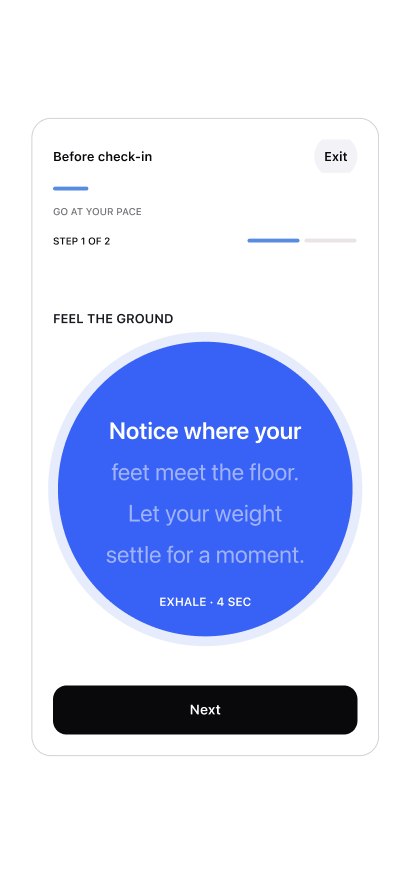
Begin the check-in with a moment of calm through breathing or body awareness, then invite reflection.
IN THE FINAL FLOW
Somatic grounding first, followed by one gentle question at a time.
02 / See connections
RESEARCH SIGNAL
Mood alone loses the event, behavior, and recurring context.
DESIGN CHOICE
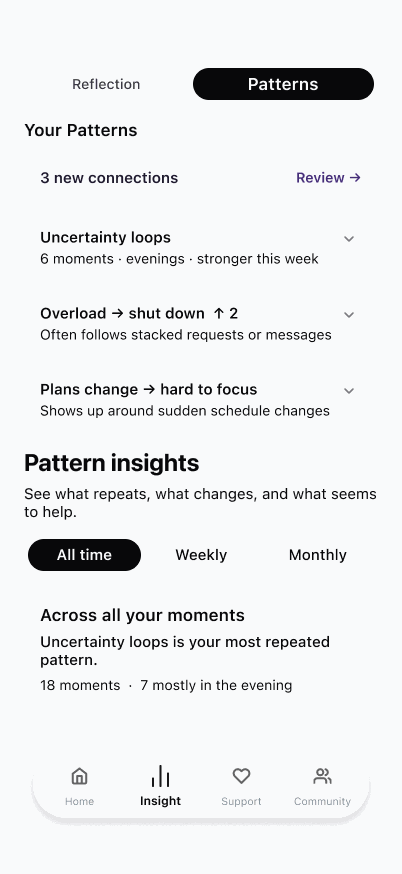
Let people review patterns, filter reflections, and open detail.
IN THE FINAL FLOW
Weekly, monthly, and all-time Insight views.
03 / Find support
RESEARCH SIGNAL
Regulation can be more useful than analysis in an activated moment.
DESIGN CHOICE
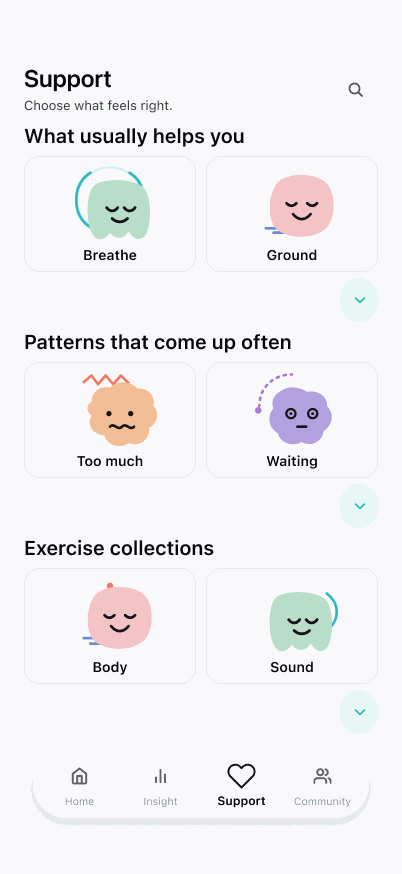
Offer practical support and several ways to engage.
IN THE FINAL FLOW
Body, Sound, Breath, Reflect, Move, Release.
04 / Keep control
RESEARCH SIGNAL
Trust depends on knowing what is private and shared.
DESIGN CHOICE
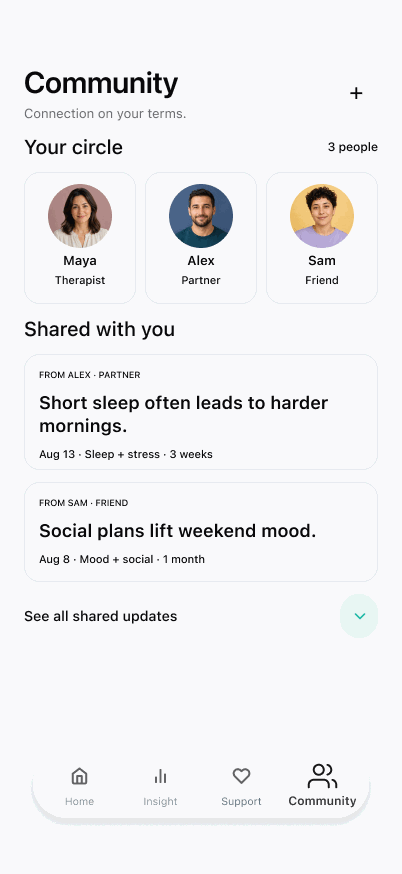
Make the private circle deliberate and reversible.
IN THE FINAL FLOW
Review sharing, choose people, pause when needed.
Design rationale / finding → principle → interface choice. No effectiveness claim is implied by these screens.
13 / UI SYSTEM
A calm visual system with
clear points of action.
The iOS Care direction uses SF Pro, quiet surfaces, a monochrome mark, and a focused cobalt accent. Named emotion faces and the breathing circle bring expression and pacing to the experience.
TYPE / SF PRO
Aa
Display 20 / 26 · Semibold
Section 16 / 22 · Semibold
Body 14 / 20 · Regular
Label 12 / 16 · Medium
Clear hierarchy and generous spacing support reading when attention is limited.
SURFACES + ACTIONS
Soft gray
White
Cobalt
Lilac
Peach
Continue
Save for later
A four-destination bar keeps Home, Insight, Support, and Community within reach. Optional paths and explicit sharing choices preserve agency.
Support collections / Body · Sound · Breath · Reflect · Move · Release
FINAL IDENTITY / TRACE



The curved t appears in black and white icon versions, with a matching wordmark. The mark can sit quietly beside the expressive care imagery.
MOTION + PACING
A circle that gives time a shape.
One continuous circle expands, rests, and contracts with the breath. It remains text-free on Home; the optional pause shows one short lyric cue at a time.


EMOTION LANGUAGE / 20 STATES
A feeling has a name, shape, and color.
The soft faces appear with text labels in check-ins and reflections. Color and expression support recognition; the person still chooses the word that fits.

Calm

Overwhelmed

Anxious

Stressed

Irritated

Frustrated

Tense

Sad

Confused

Drained

Restless

Relieved

Numb

Guilty

Lonely

Hopeful

Supported

Proud

Embarrassed

Unsupported
14 / ONBOARDING
Choice is part of the first experience.
The current onboarding frames explain the purpose, make a baseline optional, and let people review privacy and setup before they begin. These controls answer the research need for agency and trust.
01 / WELCOME
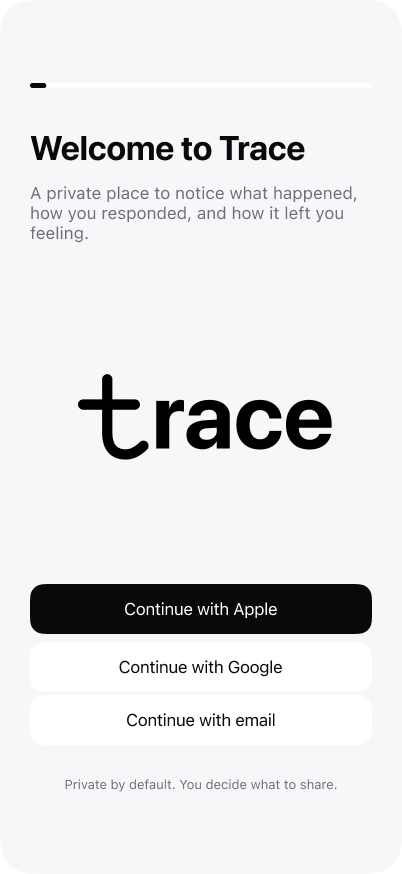
State the promise.
A private place for moments, responses, and feelings.
02 / BASELINE
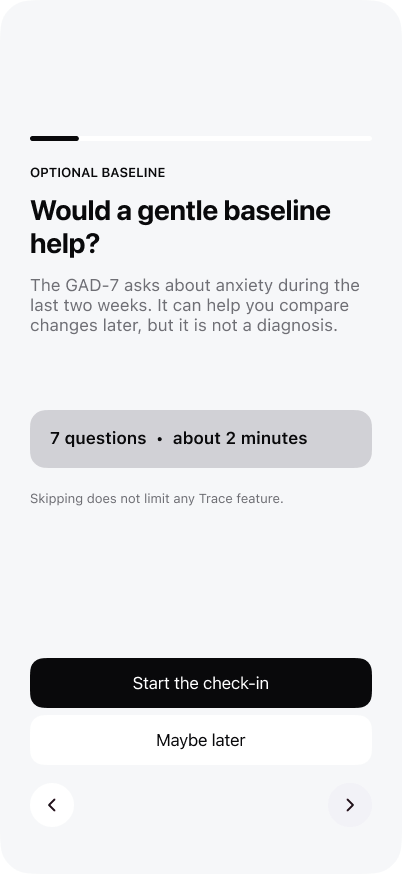
Make it optional.
The GAD-7 can be skipped without losing a feature.
03 / PRIVACY
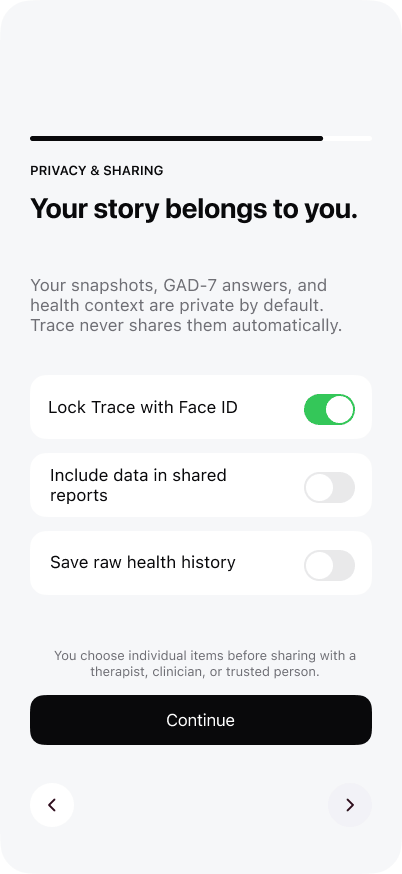
Explain boundaries.
Sharing, health context, and app lock remain explicit choices.
04 / REVIEW
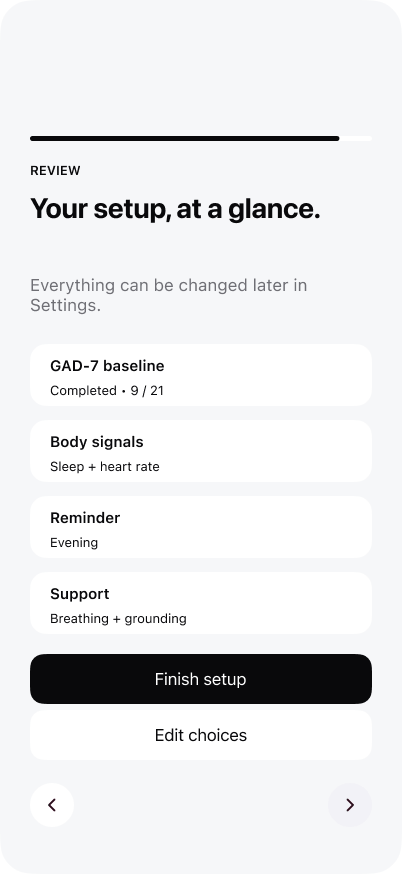
Allow change.
A summary makes settings visible and editable.
RESEARCH LINK / Participants wanted support without pressure and control over what is saved or shared.
15 / BEFORE CHECK-IN
First, make room to arrive.
The revised flow offers a short somatic pause before asking for words. It is skippable, uses paced visual and lyric cues, then lets a person capture, seek support, or leave without completing a check-in.
01 / ARRIVE
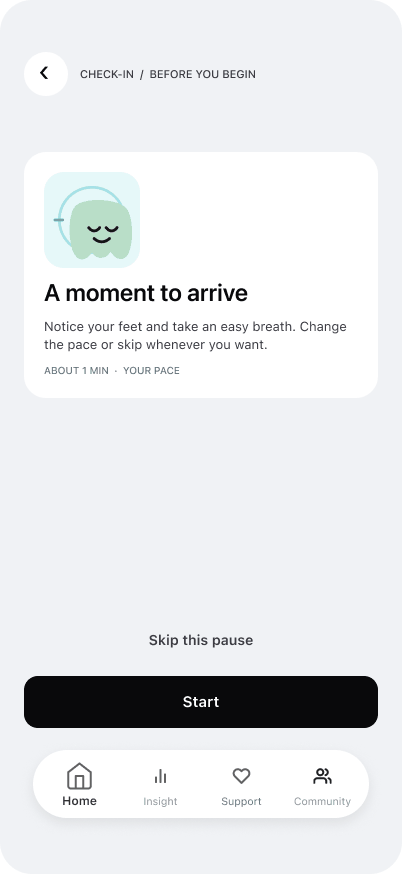
Notice the choice.
A one-minute invitation; “Skip this pause” stays visible.
02 / GROUND
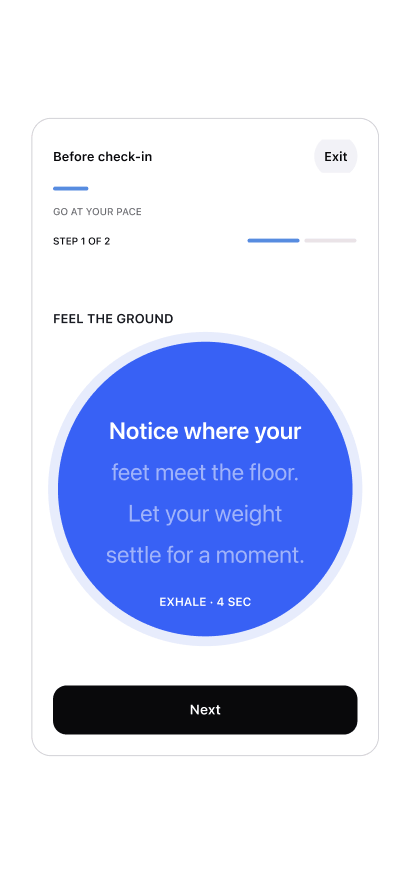
Feel the ground.
A focused prompt starts with feet and the body.
03 / BREATHE
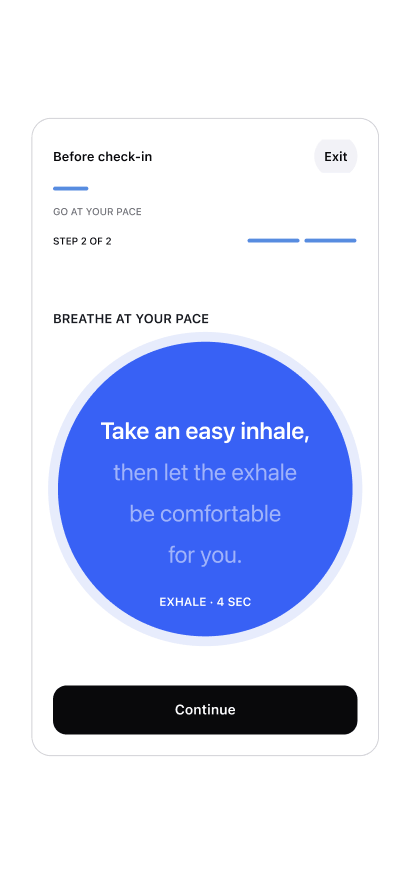
Pace the breath.
The circle carries one line at a time; no long instructions.
04 / CHOOSE
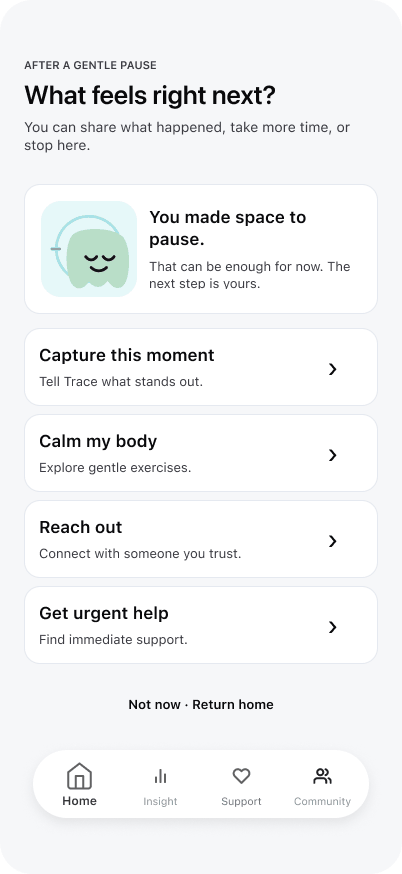
Decide what comes next.
Capture, calm, reach out, get urgent help, or stop here.
The pause is an invitation, not a gate: skip, exit, and support paths remain available.
16 / FINAL EXPERIENCE
From check-in to clearer patterns.
The current journey runs from an optional pause into a lightweight conversation, then toward pattern review and support. Each step remains paced by the person.
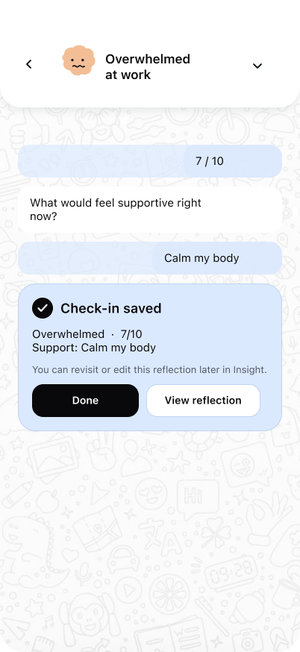
CHECK-IN / 01
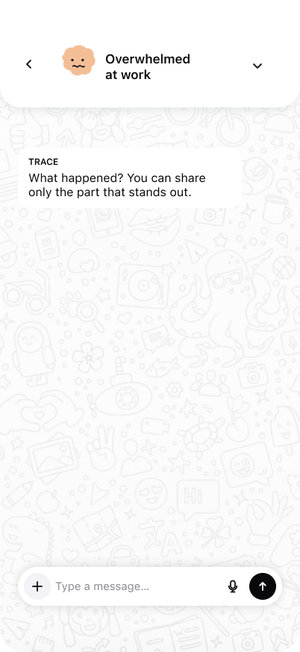
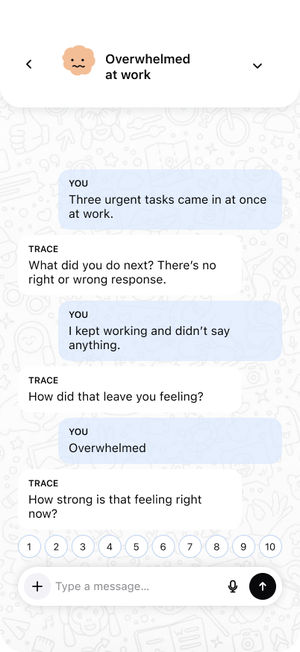
When ready, name
the moment.
After the optional pause—or a skip—the check-in asks one question at a time. Earlier answers remain visible, so the person can follow their own thread without starting over.
Pause or skip → event → feeling → intensity → saved moment
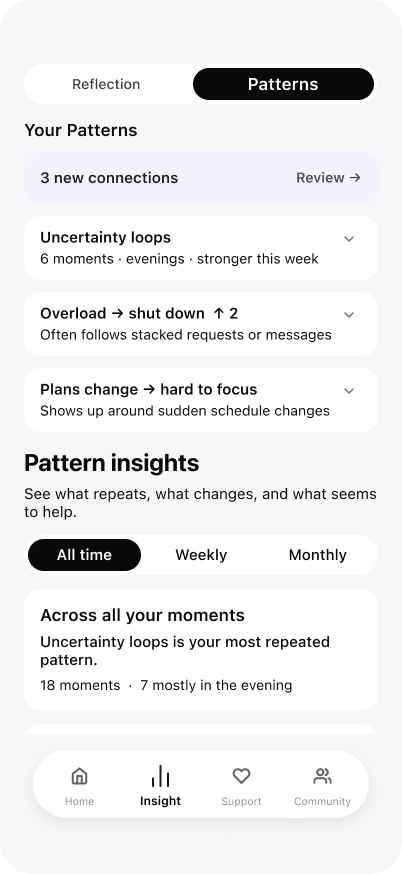
INSIGHT / 02
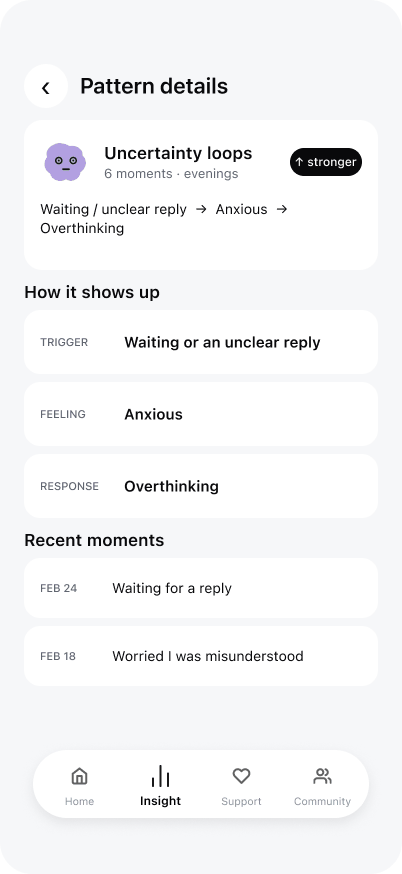
Repetition becomes
something to review.
Search reflections, review a new connection, or open a recurring pattern. Weekly and monthly views make change easier to notice.
A connection is an invitation to reflect.
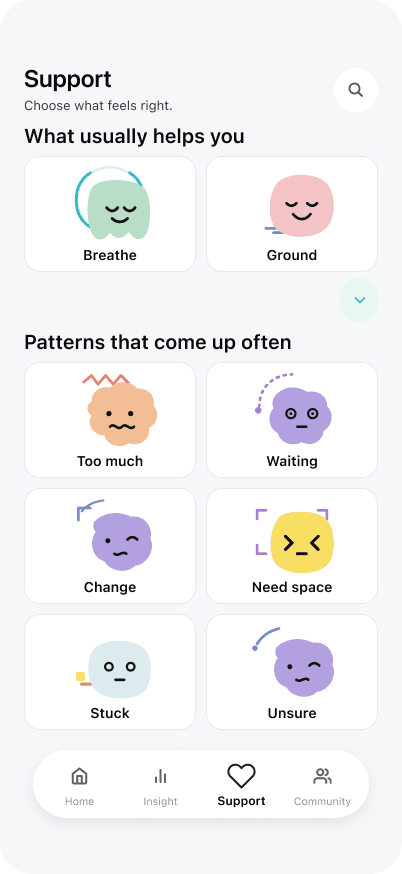
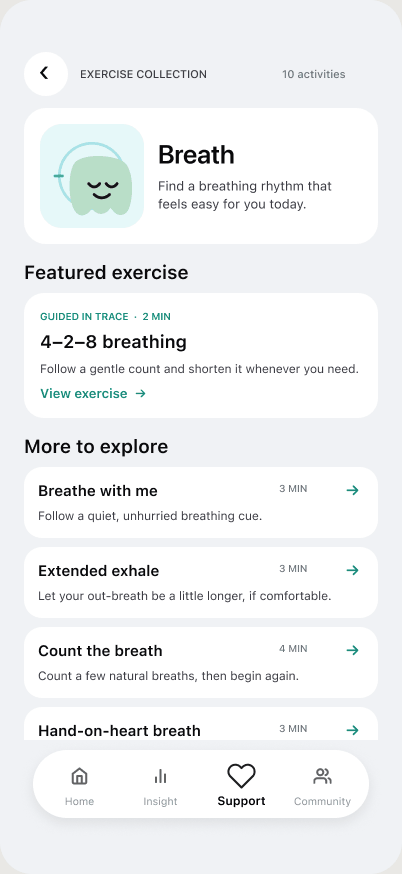
17 / SUPPORT
Care can begin before analysis.
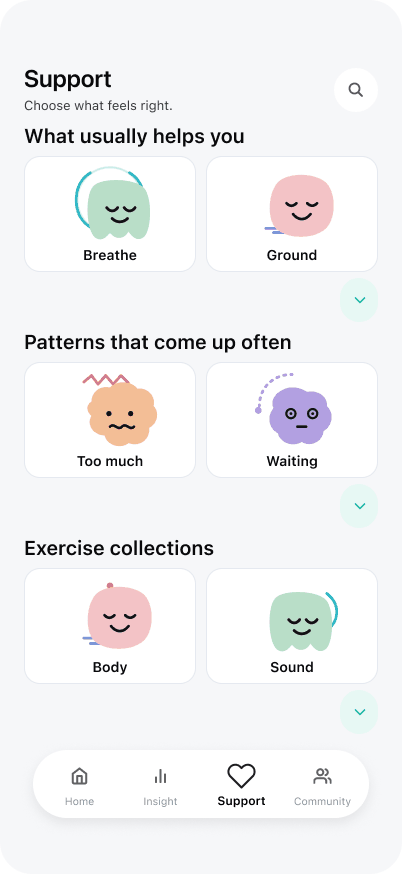
Support responds to capacity: a small action now, or a deeper reflection when someone feels ready.
Choose what helps
right now.
Trace groups options into what usually helps, patterns that come up often, and exercise collections. Breath, body, sound, reflection, movement, and release are available without forcing a long check-in.
Gentle choices remain visible and easy to leave.
18 / COMMUNITY
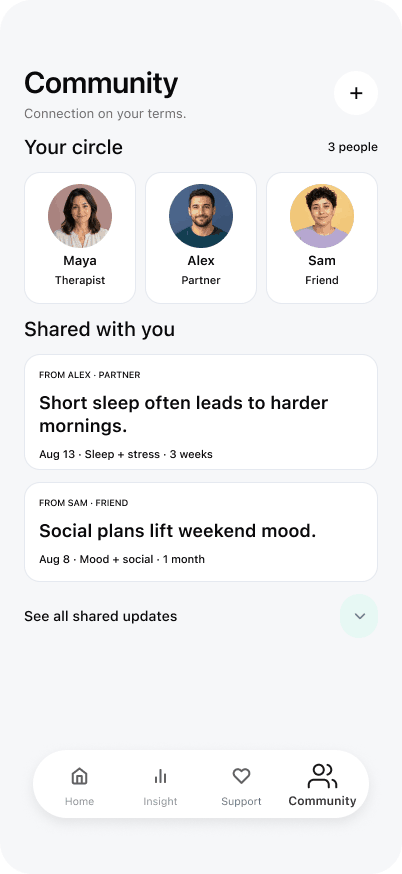
Connection, with clear boundaries.
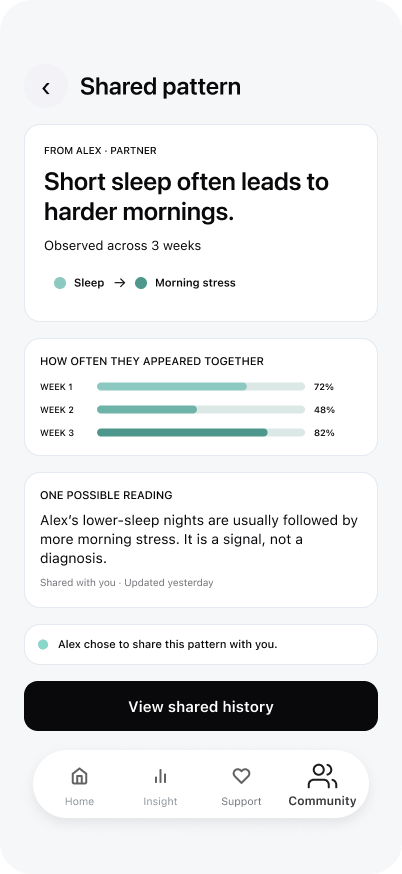
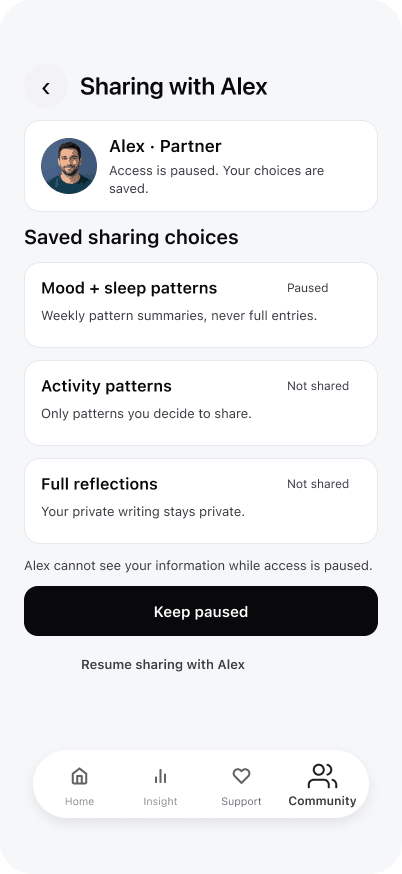
A trusted circle can make patterns easier to talk about. The person remains in control of what is shared and when sharing pauses.
SHARING / 03
Invite care.
Keep control.
The circle brings shared patterns and reflections into one place. Invitations, visibility choices, and a pause state make sharing understandable and reversible.
The person decides who belongs in the conversation.
19 / TESTING IN PROGRESS
What the testing needs
to answer.
The testing phase is in progress. These questions guide the planned evaluation of comprehension, emotional fit, and use between sessions. Findings are not yet available.
01 / Check in
Can someone choose to pause or skip, then capture a moment without feeling pushed into a long entry?
WHAT TO OBSERVE
Observe choice, hesitation, skipped prompts, completion, and how the language feels under stress.
02 / Interpret a pattern
Can someone explain what a connection means—and where it comes from?
WHAT TO OBSERVE
Probe trust, interpretation, and whether a pattern feels useful or overconfident.
03 / Control sharing
Can someone tell what remains private, choose what to share, and pause it?
WHAT TO OBSERVE
Observe comprehension of boundaries and recovery from a changed decision.
STATUS / Testing in progress. These are research questions, not findings or proof of therapeutic outcomes.
20 / REFLECTION + TESTING
Testing is in progress.
The prototype makes the research direction tangible. Testing is in progress, so this case study does not yet report usability findings or therapeutic outcomes.
WHAT THE CONCEPT MAKES POSSIBLE
• Keep event, response, and feeling together
• Review connections without diagnostic labels
• Choose support according to capacity
• Control sharing with a trusted circle
WHAT I AM TESTING
• Check-in comprehension and effort
• Safety and usefulness during stressful use
• Trust in pattern explanations
• Clarity of sharing and pause controls
The testing phase is in progress. Moderated usability sessions are the next step, followed by a short diary study. Findings and design changes will be added here.